






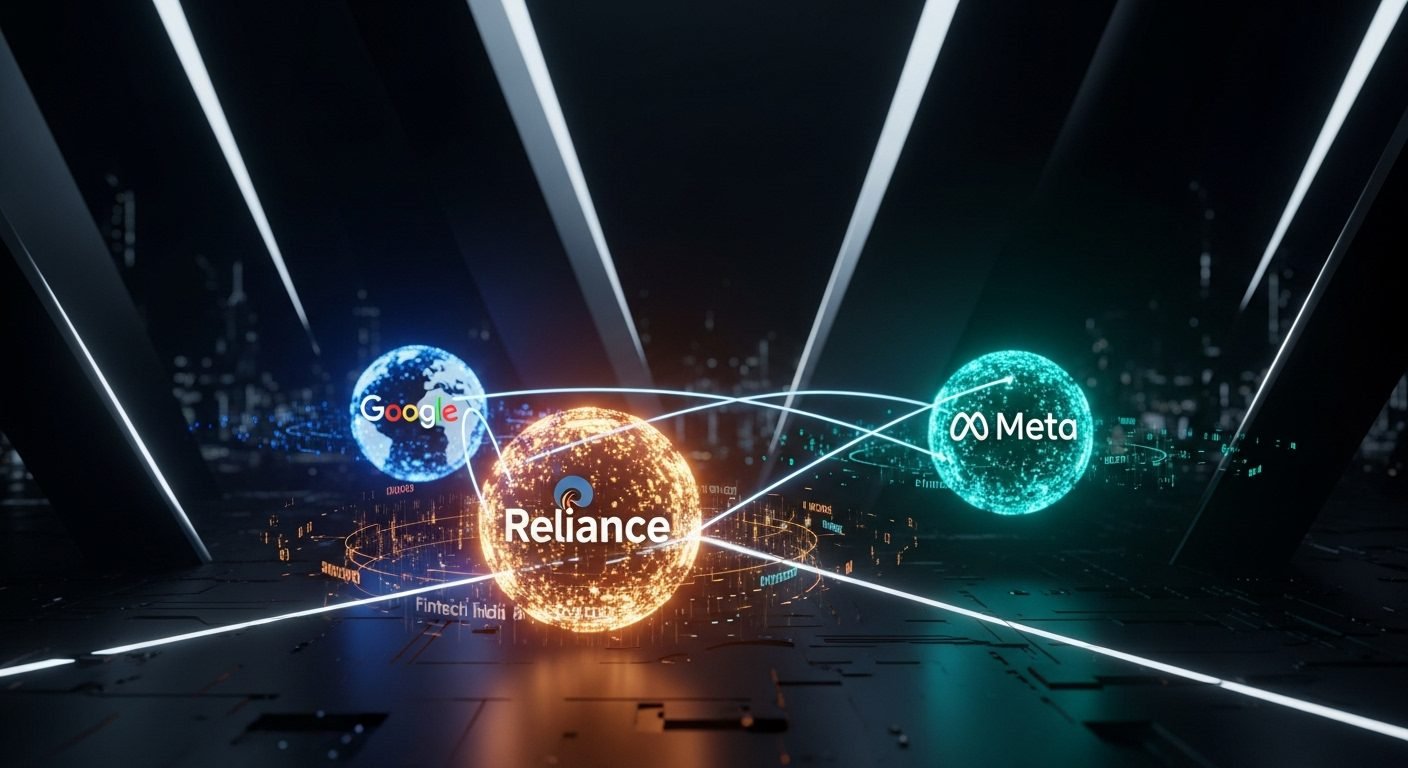
“AI everywhere for every Indian.” That audacious vision, articulated by Chairman Mukesh Ambani, is now the driving force behind Reliance Industries Limited’s (RIL) latest strategic pivot: a full-throttle dive into artificial intelligence. Unveiled at RIL’s Annual General Meeting on August 29, 2025, the launch of Reliance Intelligence, a new wholly-owned subsidiary, marks not just an expansion, but a calculated strategic offensive. This initiative is underpinned by two significant global alliances with Meta and Alphabet’s Google, setting the stage for RIL to become a linchpin in India’s rapidly ascending digital economy.
Reliance’s historical acumen for entering transformative sectors at critical junctures, from textiles to petrochemicals and the revolutionary launch of Jio, finds its next frontier in AI. This move positions Reliance to capture a significant share of India’s AI market, projected to skyrocket from $7.84 billion in 2025 to an astounding $257.45 billion by 2035. For institutional investors and savvy entrepreneurs, understanding the intricate layers of these alliances is paramount to assessing Reliance’s next growth engine.
Strategic Architects: Unpacking the Dual AI Alliances
Reliance’s AI strategy is a masterclass in securing diversified capabilities and market reach. Reliance Intelligence provides a centralized vehicle, its power amplified by leveraging the distinct strengths of two technology titans.
The Meta Joint Venture, initially valued at approximately Rs 855 crore (USD 100 million), sees Reliance holding a commanding 70% stake. This collaboration is explicitly engineered to develop and scale enterprise AI solutions for businesses across India and selected international markets. [Visual: Diagram showing Meta JV ownership structure] The JV will harness Meta’s open-source Llama AI models to offer an “Enterprise AI Platform-as-a-Service,” aligning with Meta CEO Mark Zuckerberg’s vision to embed Llama models into real-world enterprise applications. Zuckerberg envisions widespread adoption of Meta’s open-source AI models in India, expanding their reach to businesses nationwide and moving towards a vision of “personal superintelligence for everyone.” This announcement directly responds to the broader industry shift towards democratizing advanced AI, signaling Meta’s intent to capture a significant share of the enterprise AI solutions market.
Concurrently, Reliance is deepening its existing collaboration with Google Cloud. This partnership focuses on deploying Google’s comprehensive AI technologies across RIL’s diverse and vast business ecosystem, spanning energy, retail, telecom, and financial services. A cornerstone of this alliance is the establishment of a dedicated, advanced AI cloud region in Jamnagar, Gujarat. [Visual: Satellite view of Jamnagar green energy data center concept] The significance of this infrastructure cannot be overstated: a gigawatt-scale data center, developed and operated by RIL, powered entirely by green energy, and seamlessly integrated with Reliance Jio’s extensive fiber network. Alphabet and Google CEO Sundar Pichai underscored this as a move to bring world-class AI and compute from Google Cloud to India, fostering widespread AI adoption across all industries, from large enterprises to small “kirana stores.” This strategic location and green energy commitment echo Reliance’s historical pattern of building foundational, future-proof infrastructure, as seen with the world’s largest refinery in the same locale, signaling a long-term play in sustainable digital infrastructure.
Together, these alliances position Reliance Intelligence to address the entire AI stack, from foundational models (Meta’s Llama) and advanced cloud compute (Google Cloud) to industry-specific enterprise solutions and vast, green-powered data center infrastructure. The strategy is designed not just for adoption but for market dominance, creating a comprehensive ecosystem that is both globally competitive and deeply localized for India’s unique market needs.
Investor Pulse
- Market Sentiment: Bullish for long-term strategic investors.
- Key Catalyst: Strategic global partnerships and green energy infrastructure.
- Time Horizon: 3-5 years for significant market capitalization impact.
The Investor’s Calculus: Unlocking Value and Navigating Market Nuances
Reliance’s aggressive AI push arrives at a moment of “seismic shift” in India’s digital economy. This trajectory, driven by government ambition, private-sector innovation, and global collaborations, provides fertile ground for Reliance’s foray. Bullish analysts view these alliances as a “high-conviction growth opportunity,” solidifying Reliance’s position as a “linchpin in India’s digital future.” Some industry experts liken Reliance partnering with Google and Meta in AI to an Indian conglomerate adopting Microsoft Windows and Linux platforms in the pre-internet era, suggesting broad proliferation of generative AI applications across the Indian economy.
A critical near-term event in this valuation narrative is the highly anticipated Initial Public Offering (IPO) of Jio Platforms, expected by the first half of 2026. This IPO is projected not only to unlock substantial value for Reliance shareholders but also to provide crucial capital for further AI and 5G expansion. It’s important to note that the IPO also represents an exit strategy for early investors in Jio Platforms, including Google and Meta, who made significant investments in 2020. This interplay of investment and potential divestment adds a layer of strategic complexity to the valuation thesis.
Despite the largely optimistic announcements, RIL’s share price settled lower by 2.2% on the day of the AGM. This immediate market reaction could be attributed to several factors: investor concerns over the substantial capital expenditure required for such ambitious undertakings, the long-term horizon for realizing the full potential of these AI ventures, or perhaps a cautious view on the intensely competitive global AI landscape. However, Ambani’s projection that Reliance’s EBITDA will more than double by 2027, propelled by this aggressive AI strategy, provides a powerful bullish counter-narrative for patient, long-term investors.
The significant AI talent deficit in India, with only 16% of IT professionals currently skilled in AI despite a projected need for 1 million by 2026, presents both a challenge and an immense opportunity for Reliance Intelligence. The new subsidiary aims to attract “world-class researchers, engineers, designers, and product builders.” If successful, this talent acquisition, combined with the robust infrastructure and global partnerships, could carve out a substantial competitive moat for Reliance in the Indian and global AI landscape. [Visual: Infographic on India’s AI talent gap]
These partnerships are poised to accelerate AI adoption across a broad spectrum of Indian sectors, including energy, retail, telecom, financial services, education, healthcare, and agriculture. The establishment of large-scale, green-energy-powered data centers and the “Enterprise AI Platform-as-a-Service” could reshape cloud and AI solution pricing for Indian startups and businesses. This positions Reliance to potentially establish India as a global hub for cutting-edge AI solutions, while democratizing access to AI technologies for the general populace through potential offerings like JioBrain, JioFrames, and JioStar. The convergence of India’s rapidly growing AI market, Reliance’s strategic investments in green energy infrastructure, and partnerships with global tech leaders presents a compelling, high-conviction play for investors seeking exposure to India’s digital transformation.
For a deeper dive into the AGM announcements and market reactions, investors can refer to detailed reports from financial news outlets. One such source provides further insights into the Reliance AGM 2025 highlights and market responses.


Thanks for sharing. I read many of your blog posts, cool, your blog is very good. https://accounts.binance.com/ru/register?ref=O9XES6KU
I don’t think the title of your article matches the content lol. Just kidding, mainly because I had some doubts after reading the article.