






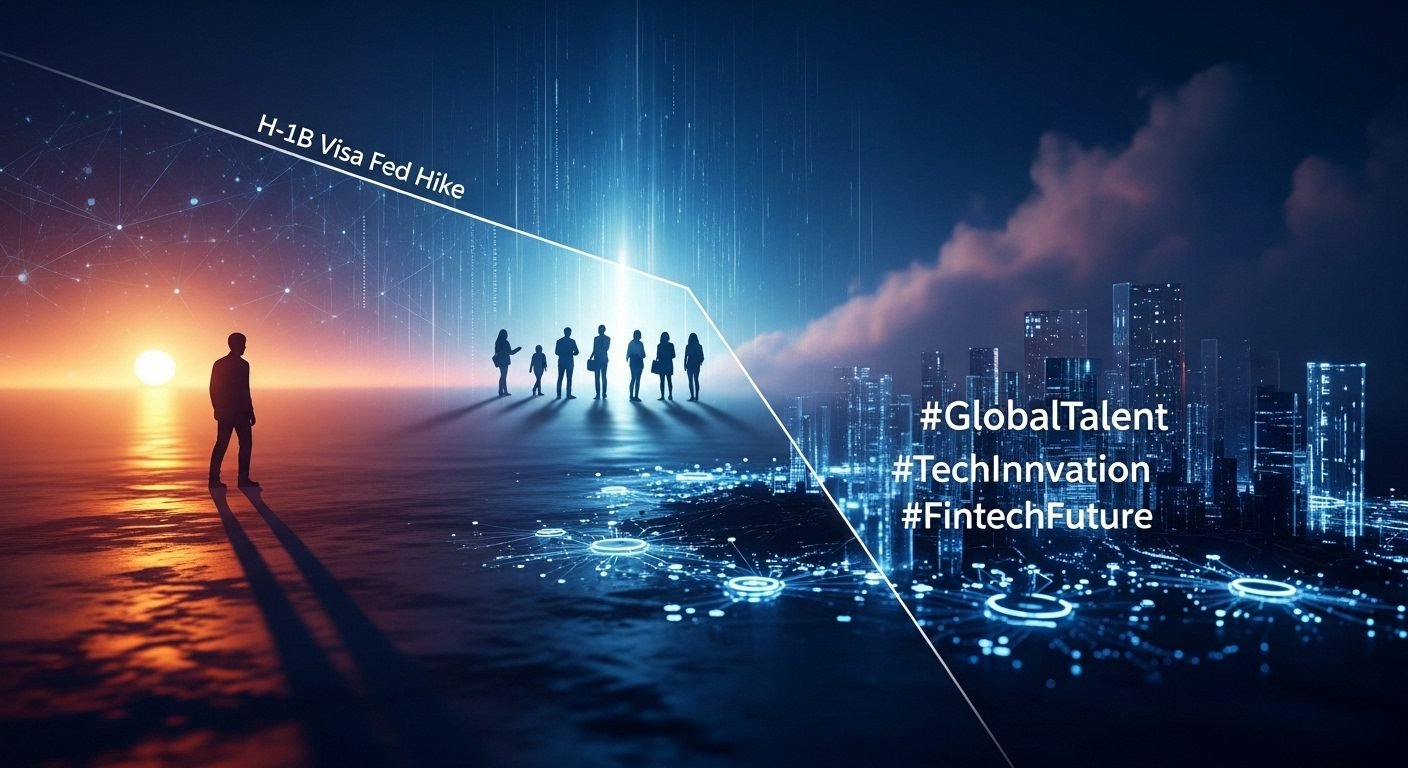
The reverberations of a single signature can rewrite the future of innovation. When President Donald Trump unveiled a “staggering” $100,000 fee for new H-1B visa applications on September 19, 2025, the global tech ecosystem held its breath. Was this a mere tariff, or a seismic shift about to recalibrate the very bedrock of Silicon Valley’s talent pipeline?
Initial panic ripped through major tech companies and current H-1B holders as details emerged of the “Restriction on Entry of Certain Nonimmigrant Workers.” The immediate scramble saw companies advising employees to rush back to the U.S., a testament to the palpable fear of disruption. However, quick clarifications from the White House, USCIS, and CBP soon diffused the most acute anxieties: the $100,000 fee is a one-time charge, exclusively for new H-1B petitions filed after September 21, 2025, for those entering from outside the U.S. Existing visas and renewals remain untouched. This narrow focus, while a relief to many, reveals a deliberate strategy: to reshape the future intake of foreign talent.
The Digital Divide Widens: A Talent Exodus on the Horizon?
This isn’t just a fee; it’s a gatekeeper, and a financially formidable one at that. While the administration frames it as a measure against “widespread program abuse” and a protection for American jobs, the tech sector’s response has been one of deep concern. Giants like Amazon and Microsoft, alongside critical Indian IT firms, see this as a “reckless” move that could stifle innovation. The $100,000 per new hire, in addition to existing costs, makes the H-1B pathway “unusable for most U.S. employers when sponsoring employees from abroad,” a stark warning from industry leaders. This immediately raises the question: where will the bleeding edge of talent go if America closes its digital doors?
The U.S. has long been a magnet for the world’s brightest, a crucible where diverse global perspectives forge groundbreaking technologies. If the cost of entry becomes prohibitive, highly skilled professionals from nations like India, who constitute over 70% of H-1B holders, may simply opt for other innovation hubs. This could accelerate a “brain drain,” diverting crucial expertise and entrepreneurial spirit to competitive markets in Canada, Europe, or Asia, fundamentally altering the global distribution of technological advancement. The directive for DHS to prioritize “high-skilled and high-paid aliens” and for DOL to increase prevailing wages further cements this selective approach, elevating the threshold for entry and making top-tier talent an even more expensive commodity.
Future Frame: Imagine a 2035 where Silicon Valley, once the undisputed nexus of global tech talent, finds itself competing fiercely with burgeoning innovation centers in Singapore, Berlin, or Toronto. The prohibitive H-1B fee, seemingly a minor fiscal adjustment today, could be viewed as the initial catalyst that fractured the U.S.’s monopoly on high-skill immigration, forcing a global redistribution of technological leadership and potentially slowing the pace of American-led innovation in critical fields like AI and quantum computing. This isn’t just about dollars; it’s about the future topography of genius.
Innovation’s New Frontier: Forging Talent or Forcing Change?
The administration’s stance is clear: protect American jobs and encourage domestic hiring. Commerce Secretary Howard Lutnick suggested this policy would filter out the “bottom quartile” of H-1B applicants, ensuring only “extraordinarily skilled” individuals enter. Yet, the reality of the U.S. tech landscape is complex; a widely cited shortage of skilled domestic graduates to fill all roles persists, leaving a vacuum that foreign talent has historically filled. This policy, therefore, acts as a forced catalyst for change, compelling companies to either invest heavily in U.S. talent development – an admirable goal – or seek alternative talent acquisition strategies.
Companies might pivot towards greater investment in reskilling American workers, or ironically, increase their offshoring efforts to retain access to global talent pools at a lower cost. Furthermore, the increased scrutiny on H-1B alternatives like L-1 visas could see them becoming the next battleground for global talent strategies. This regulatory shake-up isn’t merely tweaking a visa program; it’s challenging the existing paradigm of how the U.S. sustains its technological edge, pushing companies to explore new frontiers in talent acquisition and development. The Global Trade Research Initiative in India, for example, posits that this fee hike might hurt America more than India, suggesting Indian IT firms already employ a significant local workforce and the measure primarily increases the cost of on-site Indian talent rather than eliminating it. It forces a re-evaluation of global operating models.
The anticipated legal challenges against this proclamation add another layer of uncertainty, hinting that this policy is far from its final form. The future of talent mobility is now firmly on the bleeding edge of legal and economic policy, with every adjustment sending ripples through the global tech market. The evolving landscape of AI development will demand an even greater pool of specialized talent, making this debate more crucial than ever. The stakes aren’t just about corporate bottom lines; they are about the very pace of human progress and innovation.
This H-1B fee hike serves as a provocative inflection point. It forces us to confront fundamental questions about national interest versus global collaboration in an increasingly interconnected world. Will this policy truly ‘upskill’ the H-1B program and foster a surge in domestic talent, or will it inadvertently accelerate a dispersion of cutting-edge innovation away from American shores? The answer lies not just in regulatory fine-tuning, but in how intelligently the global tech community adapts to this new, more challenging frontier of talent acquisition. Future of work models are clearly changing, and this policy is a stark reminder.



Your point of view caught my eye and was very interesting. Thanks. I have a question for you. https://accounts.binance.com/lv/register?ref=SMUBFN5I