




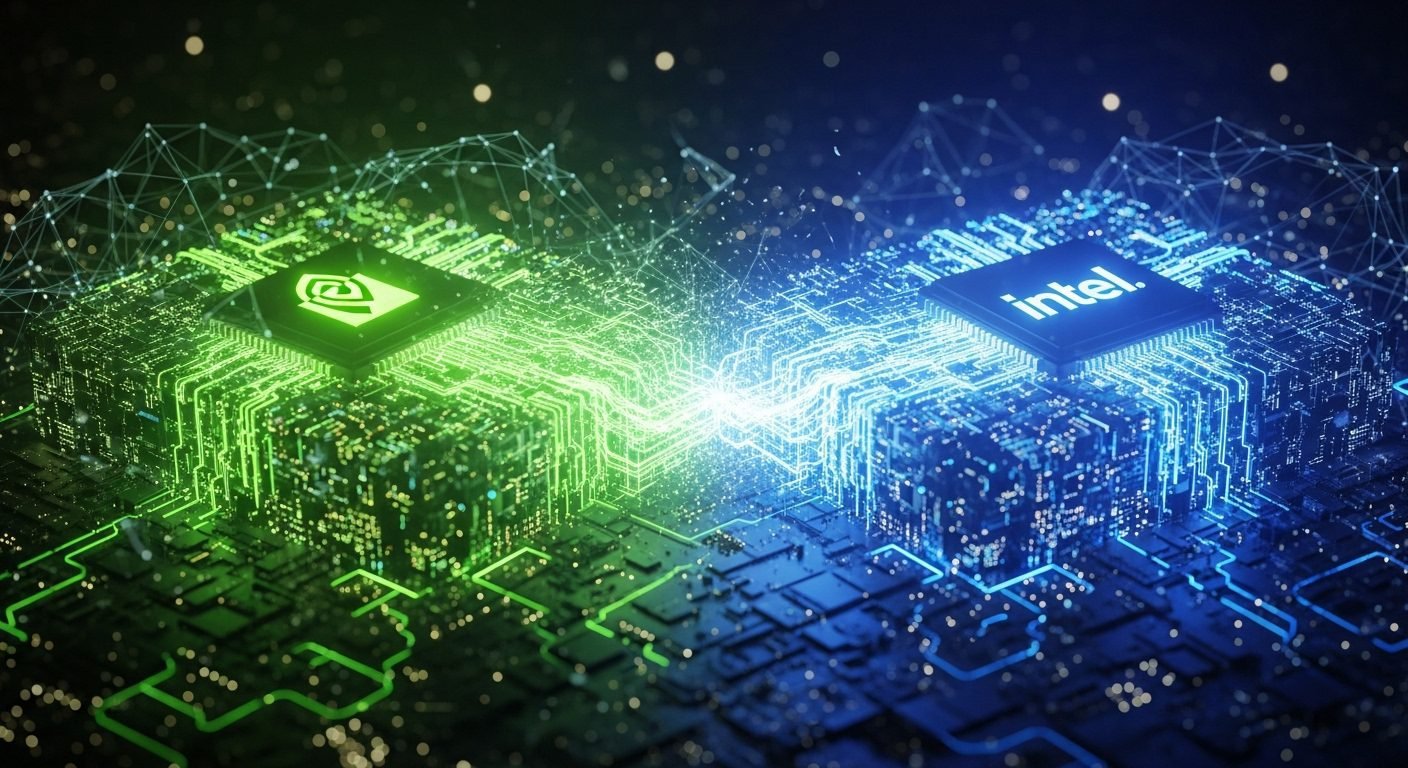
For decades, the semiconductor industry has been defined by fierce rivalries, but a tectonic plate shift just occurred that promises to rewrite the rules entirely. Nvidia, the reigning titan of AI, has not merely invested $5 billion in its erstwhile competitor, Intel; it has forged an alliance that could redefine computing as we know it. This isn’t just a corporate merger; it’s a strategic maneuver born from necessity and vision.
Intel, once the undisputed king, has stumbled, reporting significant losses and missing critical shifts in mobile and AI. Meanwhile, the geopolitical winds, underscored by a recent U.S. government stake and SoftBank’s investment, demand a stronger domestic semiconductor front. Nvidia’s move comes at a time when the stakes for technological leadership couldn’t be higher, particularly with global competition intensifying from regions like China.
The Fusion of Brains: AI Meets x86
The core of this partnership lies in a profound technological convergence. Nvidia, leading the charge in accelerated computing and AI, is now embedding its DNA directly into Intel’s foundational x86 ecosystem. For data centers, this means custom x86 CPUs from Intel, designed to integrate seamlessly with Nvidia’s AI infrastructure via NVLink. Imagine data centers where every computational muscle works in perfect harmony, unburdened by traditional bottlenecks.
This isn’t just about sharing IP; it’s about co-creating the next-generation processing units that will power the AI revolution. Nvidia CEO Jensen Huang boldly claims this collaboration targets an additional $50 billion annual market opportunity, a staggering figure that speaks to the scale of their ambition. It’s a strategic embrace of Intel’s deep expertise in CPU design, supercharging it with Nvidia’s unparalleled AI acceleration.
Future Frame: This convergence isn’t just about faster chips; it heralds an era where the very architecture of computing becomes fluid, adaptive, and intrinsically intelligent. We’re looking at a future where the lines between CPU and GPU blur, giving rise to processing units that learn, predict, and optimize operations in real-time, driving autonomous systems and hyper-personalized digital experiences at an unprecedented scale. This is the bedrock for true artificial general intelligence.
Rewriting the PC Playbook: Gaming’s Next Frontier
Beyond the colossal data center implications, the partnership’s ripples will fundamentally reshape the personal computing landscape. Intel will develop ‘Intel x86 RTX SOCs,’ integrating Nvidia’s powerful GeForce RTX GPU chiplets directly into their x86 system-on-chips. This promises a dramatic leap for high-performance PCs, particularly for thin-and-light gaming laptops, where integrated graphics have traditionally lagged.
Think about what this means: unprecedented graphics performance, real-time ray tracing, and AI-powered capabilities like DLSS, all native to the Intel platform. This strategic move directly challenges AMD’s long-standing advantage in integrated APUs, setting the stage for a new battleground in consumer technology. As PCMag aptly puts it, this is ‘the chip partnership that could rewrite the PC playbook.’ Read more about it here: PCMag Analysis of the Partnership.
The consumer will be the ultimate winner, experiencing a paradigm shift in what’s possible from a portable device. Explore the future of mobile AI processing here. This is not merely an incremental upgrade; it’s a re-imagining of the personal computer’s core capabilities, driven by the insatiable demand for immersive gaming and on-device AI acceleration.
While regulatory approvals are still pending, and the near-term financial impact remains a subject of analyst scrutiny, the long-term vision is clear. This alliance is a pivotal moment for both companies and the broader industry, fostering intensified competition and accelerating the development of hybrid CPU-GPU architectures. It’s a bold bet on a future where collaboration, even among rivals, is the key to unlocking the next epoch of technological innovation. The question isn’t if this will reshape computing, but how profoundly. Discover more about semiconductor industry mergers and acquisitions.