






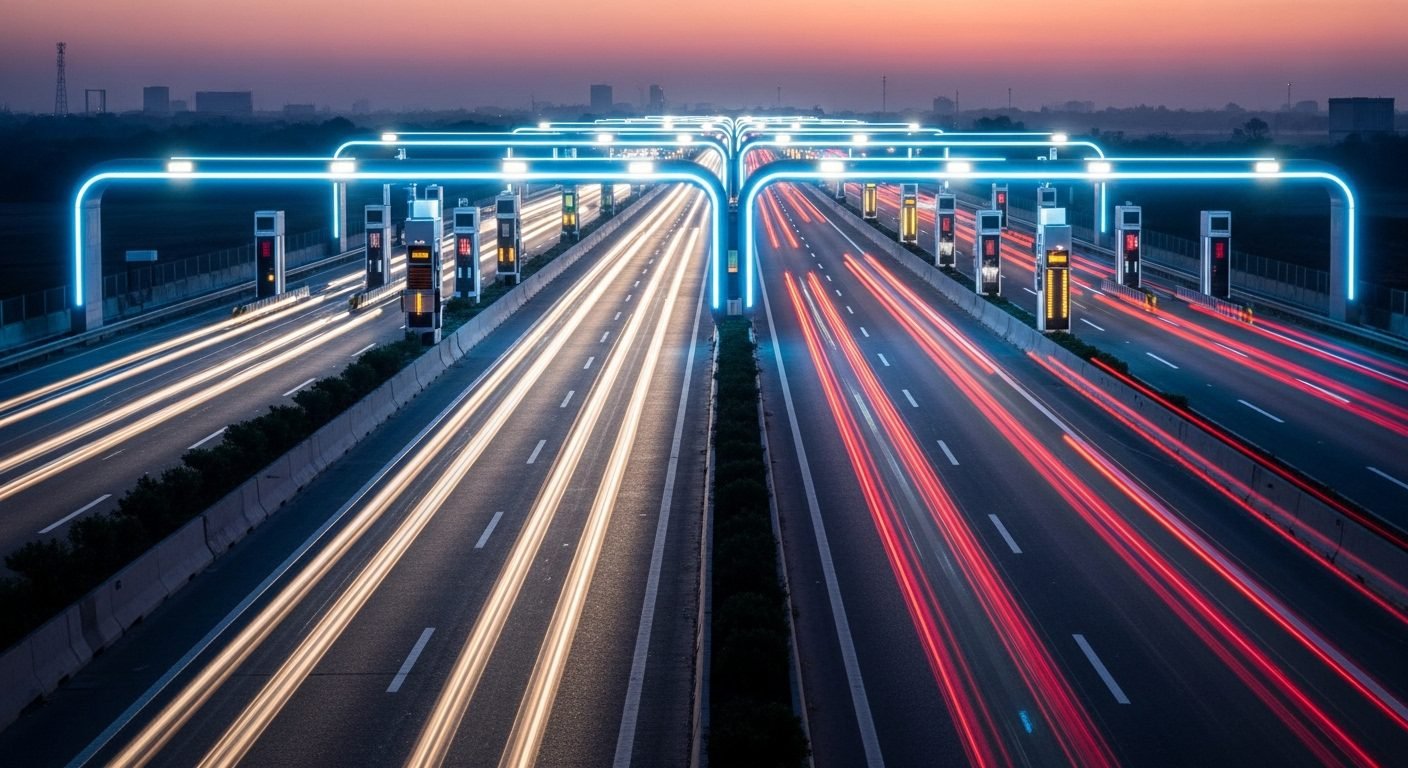
Imagine a highway journey where the flow never breaks, where the constant rhythm of the road isn’t interrupted by the jarring stop-and-go of a toll plaza. India is on the brink of transforming this vision into reality with the introduction of its first Multi-Lane Free Flow (MLFF) tolling system. This innovative step promises to reshape commutes, elevate business efficiency, and make our nation’s highways genuinely smarter.
This isn’t just a concept for the future; it’s becoming tangible. The Indian Highways Management Company Limited (IHMCL), a subsidiary of the National Highways Authority of India (NHAI), has partnered with ICICI Bank to bring this pioneering system to life. The pilot project for barrier-free tolling will launch at the Choryasi Fee Plaza on National Highway 48 (NH-48) in Gujarat, with operations slated to commence in early 2026. A parallel agreement has also been inked for implementation at Gharaunda Fee Plaza on NH-44 in Haryana, signaling a strategic, phased rollout. [Visual: Diagram showing traffic flowing through an MLFF gantry]
NHAI Chairman Santosh Kumar Yadav highlighted this agreement as “a significant milestone in the evolution and modernization of tolling in India,” laying a foundation for a more efficient, transparent, and user-friendly system. This initial rollout is a substantial move, as NHAI plans to extend MLFF-based tolling to approximately 25 National Highway fee plazas nationwide during the current financial year (FY 2025-26).
How MLFF Works and What It Means for You
Multi-Lane Free Flow tolling fundamentally eliminates physical toll booths. Instead, high-performance RFID readers scan your existing FASTag, while advanced Automatic Number Plate Recognition (ANPR) cameras identify your vehicle as you drive through at highway speeds. The toll is automatically deducted from your linked account, making the entire process invisible and seamless. [Visual: Infographic illustrating the RFID/ANPR process]
This system is the logical next step from the existing FASTag infrastructure, which already digitized toll collection. With MLFF, the goal is to achieve total barrier-free movement, significantly cutting down on congestion and improving the overall travel experience.
For the everyday commuter, this translates directly into noticeable benefits:
* Reduced Congestion and Saved Time: No more queuing. Vehicles pass through toll points continuously, giving you back valuable minutes in your day.
* Fuel Efficiency and Lower Emissions: Less stopping and starting means less fuel consumption. This reduction in idling contributes to both cost savings for drivers and a decrease in carbon emissions, supporting India’s “smarter, faster, and greener” highway objectives.
* Smoother, Less Stressful Journeys: The entire travel experience becomes more predictable and less tiring, particularly on long drives.
Practical Takeaways for Commuters
- Ensure Your FASTag is Active: Verify your existing FASTag is working correctly and linked to a funded account.
- Top Up Regularly: Maintain a sufficient balance to avoid payment issues and ensure uninterrupted travel.
- Check Your Bank Linkage: Confirm your FASTag is properly connected to your bank account (ICICI Bank is a key partner for this initiative).
Operational Edge for Businesses
For small and large businesses alike, especially those in logistics, transportation, or delivery services, Multi-Lane Free Flow tolling represents a significant operational upgrade. Time is money, and every minute saved on the road directly impacts the bottom line.
- Boosted Logistics Efficiency: Commercial vehicles can maintain continuous speeds, leading to faster transit times for goods. This improved predictability allows businesses to optimize routing and delivery schedules, reducing lead times and enhancing customer satisfaction.
- Reduced Operational Costs: Lower fuel consumption from less idling means substantial savings over time for commercial fleets. These savings can directly impact operational costs, potentially enabling businesses to offer more competitive pricing for their services.
- Enhanced Transparency: The automated system improves the transparency of toll revenue collection. For businesses, this means more accurate record-keeping and potentially less administrative overhead related to manual toll payments. This initiative aligns with India’s broader objective to move towards “smarter, faster, and greener road infrastructure,” mirroring global trends in intelligent transportation systems and digital transformation.
What to Watch Next
The pilot projects in Gujarat and Haryana will serve as vital learning grounds. The Indian Highways Management Company Limited (IHMCL) and its partners will gather data, identify potential issues, and fine-tune the MLFF technology and operational protocols before a wider rollout. This methodical approach underscores a commitment to robust implementation.
Getting Ready for the Future of Indian Highways
- Monitor NHAI Announcements: Stay informed on the rollout schedule for your frequently used routes.
- Educate Your Fleet Drivers: For businesses, ensure your drivers understand the barrier-free system and maintain active FASTags.
- Embrace Digital Payments: This move further solidifies India’s digital payment ecosystem; get comfortable with online management of your FASTag.
The long-term vision is a nationwide transformation of tolling, creating a more cohesive and efficient national highway network that benefits everyone. From daily commuters to large-scale logistics operations, this move firmly positions India as a leader in adopting advanced intelligent transportation systems. This commitment paves the way for a more connected and efficient future on its highways. For more details on the National Highways Authority of India (NHAI) initiatives and FASTag functionalities, visit the official NHAI or IHMCL websites.


Thank you for your sharing. I am worried that I lack creative ideas. It is your article that makes me full of hope. Thank you. But, I have a question, can you help me? https://accounts.binance.com/ar/register-person?ref=53551167
I don’t think the title of your article matches the content lol. Just kidding, mainly because I had some doubts after reading the article.
Your point of view caught my eye and was very interesting. Thanks. I have a question for you. https://accounts.binance.info/da-DK/register-person?ref=V3MG69RO
I don’t think the title of your article matches the content lol. Just kidding, mainly because I had some doubts after reading the article. https://www.binance.com/en-ZA/register?ref=B4EPR6J0