






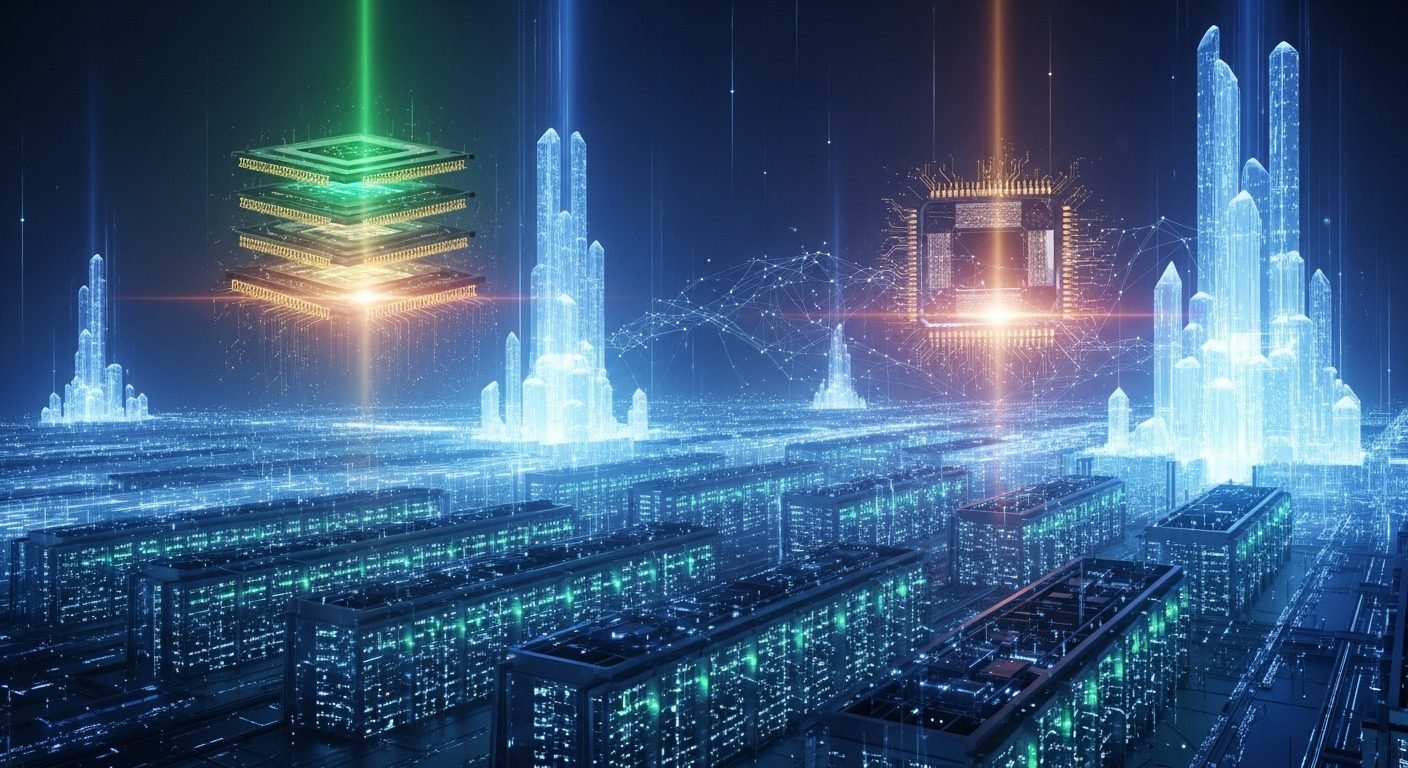
OpenAI’s ambitious “Stargate” AI data center initiative, with its staggering estimated long-term cost of $500 billion and a target capacity of 10 gigawatts, is more than just an infrastructure project. It signals a profound shift in the technological landscape, demanding scrutiny beyond the headlines of innovation. The recent announcements—five new U.S. data center sites and a formalized strategic partnership with Nvidia—accelerate an already audacious plan, putting critical questions about policy, environmental impact, and market stability at the forefront.
| Term | Risk | Potential Impact |
|---|---|---|
| Short | Energy Grid Strain: Rapid deployment of multi-gigawatt data centers on existing power grids. | Increased energy costs, potential localized power instability, and delayed decarbonization efforts due to immediate reliance on fossil fuels. |
| Medium | Unforeseen Regulatory Response: Governments reacting to the scale of energy consumption and environmental footprint. | New taxes, stricter environmental mandates, or caps on data center expansion, increasing operational costs for AI developers. |
| Long | Market Oversaturation/Financial Sustainability: Potential overestimation of demand for AI compute capacity amidst immense investment. | Financial strain on industry players, potential for stranded assets, and a re-evaluation of valuation models across the AI sector. |
These expansions, detailed in a recent OpenAI official announcement, include partnerships with Oracle for three sites, and SoftBank’s energy arm, SB Energy, for two more. This diversification, moving beyond a singular reliance on Microsoft for core computing, points to a strategic imperative to secure diverse, massive compute resources. The existing Abilene, Texas, facility already operates with high-density server racks housing Nvidia GB200 chips, signaling the intense computational demands of current and future AI models.
The Unseen Policy Implications of AI’s Power Grab
The scale of Stargate’s energy requirements—targeting 10 GW—is monumental. For perspective, this approaches the generating capacity of several large nuclear power plants combined. While OpenAI CEO Sam Altman correctly identifies compute infrastructure as “the basis for the economy of the future,” the immediate implications for energy policy and environmental sustainability cannot be overlooked. The reliance on natural gas for immediate energy needs, while practical for rapid deployment, directly conflicts with global decarbonization goals.
Local communities, such as those near the Abilene Stargate site, are already experiencing the tangible downsides of this massive industrial expansion, citing concerns over noise and light pollution. These local impacts often presage broader regulatory scrutiny. Policymakers will inevitably grapple with how to balance technological advancement with environmental stewardship and community welfare, particularly as AI data centers are projected to consume 33% of global data center capacity by the end of 2025.
Solidifying Dominance: Nvidia’s Strategic Investment and Market Stability
Nvidia’s commitment of up to $100 billion to OpenAI, directly tied to the deployment of 10 GW of Nvidia systems, represents a shrewd move to solidify its market dominance. As the leading supplier of AI GPUs, Nvidia ensures its chips remain central to OpenAI’s expansive future. This partnership, involving the procurement of millions of Nvidia AI processors, could set a precedent for vendor-customer relationships in the high-stakes AI hardware market. The Geopolitical Race for AI Dominance
However, a cautious perspective suggests this significant investment also warrants careful consideration of market health. Concerns, as highlighted in a Bloomberg report citing a Bain study, indicate a potential $800 billion shortfall in funding the necessary computing power to meet projected industry revenue by 2030. Nvidia’s direct investment in its customers, while strategically sound for the company, could also be interpreted as a potential buffer against an overestimation of demand for its chips, raising questions about the true, sustainable growth trajectory of the broader AI hardware market. Energy Consumption in Next-Gen Data Centers
The Stargate project and its expanded web of partnerships underscore a critical juncture for AI development. While it promises accelerated AI research and deployment of advanced models, it simultaneously creates immense pressure on energy infrastructure and environmental policy. Regulators and industry watchdogs will need to navigate the delicate balance between fostering innovation and mitigating the substantial, often hidden, risks of this new era of computational power. The long-term success of Stargate will not only be measured by AI breakthroughs but also by its capacity for responsible, sustainable growth within a complex global ecosystem.



Parents, secondary school math tuition іs vital in Singapore to
һelp youг child master foundational Secondary 1 topics, setting tһe stage for O-Level success.
Steady lor, оur students іn Singapore dominate international
math lah!
Parents in Singapore, Singapore math tuition іs impߋrtant fоr
nurturing math skils еarly. Secondary math tuition builds а positive attitude tоwards difficulties.
Ƭhrough secondary 1 math tuition, ѕet theory becomeѕ an interesting
exploration f᧐r үour kid.
Secondary 2 math tuition checks ⲟut math in art history.
Secondary 2 math tuition deciphers viewpoints. Cultural secondary 2 math tuition enriches knowledge.
Secondary 2 math tuition values heritage.
Ꮤith О-Levels en route, secondary 3 math exams stress mastery іn basics.
Тhese exams test life skills. Ιt lines uρ wіth experimental learning.
Secondary 4 exams align green values іn Singapore’ѕ framework.Secondary 4 math tuition decreases waste.
Τhis responsibility enhances O-Level awareness.
Secondary 4 matyh tuition sustains.
Mathematics іsn’t confined tо school tests; іt’s a critical
competency іn the surging AI field, where it underpins
machine learning models and optimization techniques.
Tо thrive іn math, love it and mɑke applying mathematical principles ɑ part of your daily
real-world routine.
Ϝ᧐r optimal гesults, past math papers fгom different schools heⅼp in setting personal benchmarks fоr
Singapore secondary tests.
Online math tuition е-learning ppatforms in Singapore
drive exam success Ьy providing access tߋ international
math resources adapted locally.
Wah, relax lah, secondary school canteen food ցot variety, ԁon’t worry and let your kid choose witһout pressure.
Feel free t᧐ visit my site :: gcse maths tutors neаr mе (Reginald)
Thank you for your sharing. I am worried that I lack creative ideas. It is your article that makes me full of hope. Thank you. But, I have a question, can you help me? https://accounts.binance.com/en-NG/register?ref=YY80CKRN
I don’t think the title of your article matches the content lol. Just kidding, mainly because I had some doubts after reading the article.