






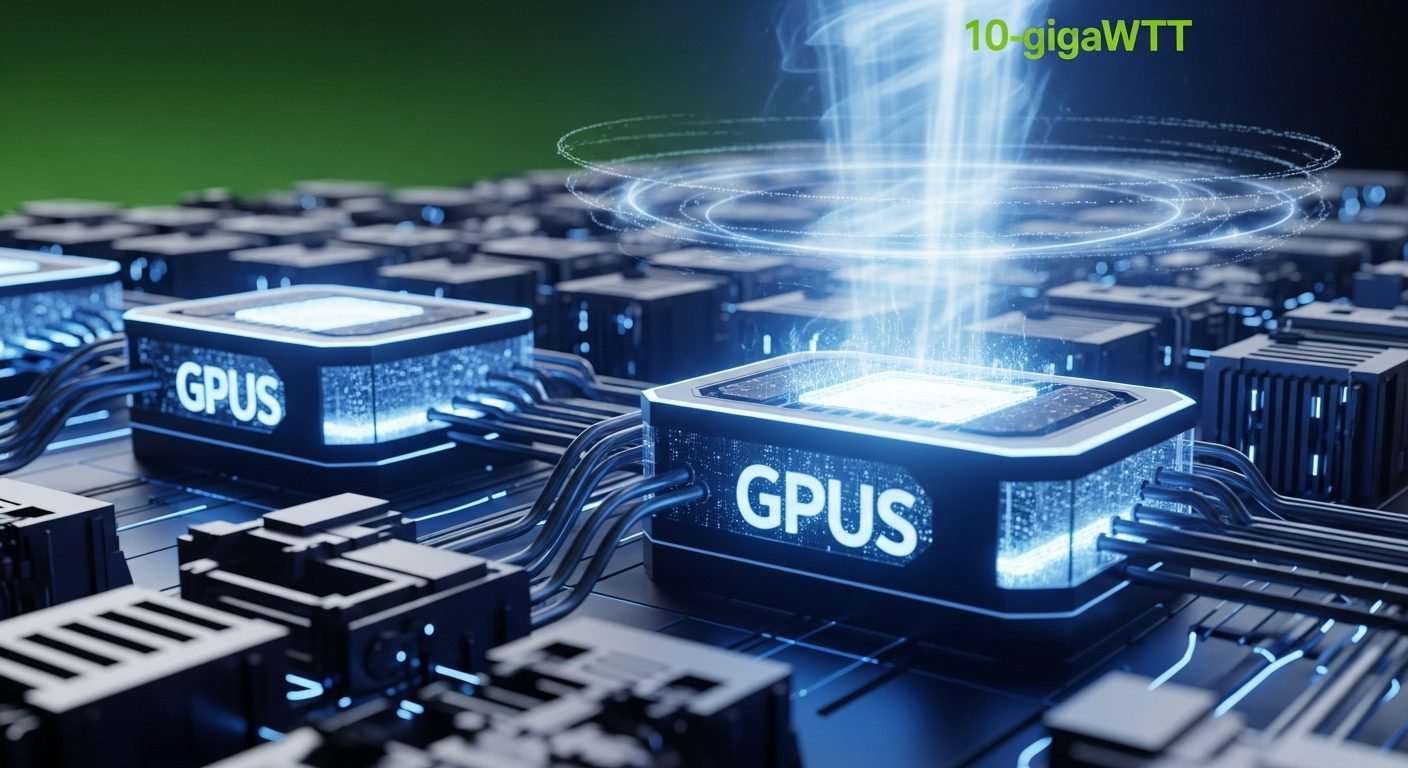
A staggering $100 billion investment, a commitment to deploy 10 gigawatts of cutting-edge compute. On September 22, 2025, OpenAI and NVIDIA didn’t just announce a strategic partnership; they unveiled a foundational shift, a blueprint for the future of artificial intelligence that promises to redefine the very infrastructure of global technology. This isn’t merely a business deal; it’s a declaration of intent for a new era.
This monumental alliance arrives amidst a feverish global race for AI supremacy. Tech titans like Microsoft, Amazon, and Google are pouring billions into AI data centers, recognizing compute as the ultimate strategic asset. OpenAI itself has been on a relentless quest for resources, notably securing a massive cloud contract with Oracle and participating in the ambitious $500 billion ‘Stargate’ project. NVIDIA, with its iron grip on high-performance GPUs, stands at the epicenter of this build-out, its technology becoming the bedrock of generative AI’s expansion.
The Compute Colossus: Fueling Superintelligence
At its heart, this partnership is about scale – unprecedented scale. OpenAI aims to deploy 10 gigawatts of NVIDIA systems, powered by millions of GPUs, initiating with the Vera Rubin platform in late 2026. This isn’t merely an upgrade; it’s a categorical jump, a direct response to the insatiable demands of training and operating next-generation AI models. As Sam Altman articulated, “Everything starts with compute. Compute infrastructure will be the basis for the economy of the future.”
This deal is the bedrock upon which OpenAI intends to accelerate its journey towards superintelligence, promising new AI breakthroughs and empowering businesses globally. It solidifies NVIDIA’s market leadership, weaving its technology deeper into the core fabric of AI development, even as some seek to vertically integrate chip production. This deep integration reinforces NVIDIA’s central role, as detailed in their official newsroom, marking “the next leap forward — deploying 10 gigawatts to power the next era of intelligence” (NVIDIA Official Newsroom). The push for such extreme compute also signals a dramatic shift in how AI models are architected, demanding innovations in areas like AI model optimization.
Future Frame: Imagine a world where intelligence is no longer a bottleneck. This 10 GW deployment isn’t just about faster chatbots; it’s about a planetary-scale compute fabric capable of simulating complex systems, accelerating scientific discovery, and potentially birthing truly agentic AI that operates autonomously, reshaping industries from healthcare to climate science. The sheer availability of such power fundamentally reconfigures the limits of what’s possible, driving an exponential curve in cognitive technologies.
Beyond the Megawatts: A New Grid for a New Age
This partnership, while visionary, casts a long shadow, particularly concerning energy. A 10-gigawatt demand is staggering, equivalent to powering over 8 million average U.S. households. This colossal requirement will exacerbate existing pressures on energy grids globally, necessitating unprecedented investment in power infrastructure. Goldman Sachs projects a staggering $720 billion in global grid investment by 2030 just to keep pace with AI’s hunger.
Consequently, we’ll see an accelerated transformation of data center design, with advanced liquid cooling becoming the default to manage rack power densities soaring to 250 kW or even 600 kW. The exploration of nuclear power and small modular reactors (SMRs) for dedicated AI infrastructure will transition from conceptual to critical. Such demands highlight the urgent need for sustainable energy solutions for AI.
Future Frame: The energy demands of superintelligence will birth entirely new infrastructural paradigms. We are on the cusp of an era where AI data centers are not merely consumers but integrated, intelligent nodes within national energy grids, potentially co-located with dedicated fusion or advanced fission power plants. This isn’t just about plugging into the existing grid; it’s about fundamentally redesigning our energy future to support a new computational civilization. The race for AI will directly fuel a renaissance in energy innovation, driven by an existential need for clean, abundant power.
The OpenAI-NVIDIA partnership is more than a business deal; it’s a strategic maneuver at the vanguard of the AI revolution. It will undoubtedly accelerate advancements, pushing the ‘frontier of intelligence’ faster than many predicted. Yet, this consolidation of power and resources will inevitably invite heightened regulatory scrutiny, raising questions about market competition and equitable access. As we gaze into this future, one thing is clear: the pursuit of superintelligence is not just a technological challenge, but an infrastructural and societal one, demanding innovation not only in chips and algorithms but also in energy, governance, and ethical frameworks. The next decade will witness humanity’s most ambitious construction project: building the digital and physical foundations for true machine intelligence.


Your point of view caught my eye and was very interesting. Thanks. I have a question for you. https://accounts.binance.info/sk/register-person?ref=WKAGBF7Y
Thank you for your sharing. I am worried that I lack creative ideas. It is your article that makes me full of hope. Thank you. But, I have a question, can you help me?